Cathedral details, modern art, Alsatian food and the European quarter, with current closures, admission prices and routes that work in rain.

Strasbourg before the Christmas rush: a car-free autumn plan
Strasbourg is more interesting when it is allowed to be a city rather than a backdrop for a Christmas-market photograph. An autumn visit can combine the cathedral's sandstone and extraordinary clock, half-timbered houses over the Ill, the broad avenues of the Neustadt and a working European institution. Three days leave room for all four, with proper meals and a museum afternoon. You do not need a car for this route, and you do not need to turn a short city break into a rushed tour of every wine village in Alsace.
Several current details materially change the plan. The Musée Alsacien is closed for works, with reopening expected in 2028. Parts of the Decorative Arts Museum are also closed during autumn 2026. The cathedral platform requires more than 300 steps, while European Parliament visits outside plenary sessions are free but require a physical identity document. This guide builds around places that can actually be used, instead of repeating an old list of attractions without checking whether their doors are open.
October is suited to a mixture of walks and interiors; November needs an even more deliberate wet-weather plan. Neither month guarantees leaf colour, empty streets or cheap rooms. Parliamentary activity and other events can affect accommodation demand. If the Christmas markets are your main reason to come, choose their officially announced dates separately. This itinerary is designed to work without them, and the meal, museum and walking suggestions do not depend on seasonal stalls operating.
Arrival: station first, then a short walk or tram
Strasbourg's railway station is a practical arrival point for a city stay. Before booking a long-distance train, compare the total journey and change times rather than the fastest advertised segment alone. Reserve the service you intend to use when the fare requires it, and allow a realistic connection if arriving from a flight elsewhere. The station and the cathedral are not next door to each other, but the central area is compact enough that a well-chosen hotel avoids a lengthy transfer.
For Strasbourg Airport, the airport's train information describes a connection to Strasbourg station taking about eight minutes, with up to five trains an hour. That is the rail journey, not the time from aircraft seat to hotel. Add disembarkation, baggage, the walk to the station and waiting for the actual service. Frequency varies through the day. A current airport-train fare was not reliably available during this research, so it is not presented as a confirmed amount; use the operator's date-specific purchase options linked from the airport.
For urban journeys, the CTS 24H SOLO costs €4.60, plus €0.20 for the first purchase of its contactless ticket support. It runs for 24 hours from first validation and permits unlimited journeys on the listed urban network, including tram D to Kehl. Reloading the existing support avoids buying another one unnecessarily. This is a useful option on the European-quarter day, when transport saves a longer return walk.
The CTS fare should not be assumed to cover the airport TER train merely because both services reach Strasbourg. Urban, regional and cross-border products have distinct rules. Consult CTS ticket information for the product matching your journey, and validate as required. Stay alert around tram tracks and cycle lanes: a pedestrian-looking space can still carry moving vehicles. For the central sightseeing days, walking with occasional tram assistance is usually simpler than repeatedly hunting for parking.
Where to stay: atmosphere versus convenience
| Base | Best reason to choose it | Check before booking |
|---|---|---|
| Grande Île, near the cathedral or Place Kléber | Easy early and late walks through the historic centre | Street noise, luggage access and whether the room has an accessible lift route |
| Petite France | Canal atmosphere and a good position for the first day's western walk | Historic buildings can mean stairs, small rooms and cobbled approaches |
| Station district | Convenient rail arrivals and departures, especially with luggage | Exact street, walking route after dark and whether the saving justifies a longer daily walk |
| Neustadt or Orangerie side | Broader streets and a useful base for the eastern city | Tram proximity and the return trip after dinner in the old centre |
For a first three-night stay, a central base or the station side of the centre works well. Orangerie accommodation makes more sense if you prefer a quieter residential setting and accept using transport. Do not choose solely by the district name: the difference between two adjacent streets can matter more than the label on a booking site. Ask about breakfast timing if you have an early train, and about secure luggage storage if the final day remains available after checkout.
No hotel rate is quoted because the useful figure is the total for your actual dates, including occupancy, local taxes and cancellation conditions. Parliamentary weeks can produce a different market from an ordinary weekend. Booking a slightly more convenient room can save both transport effort and the temptation to skip an evening walk because the return feels cumbersome.
Day one: Petite France, the waterways and modern art
09:30–12:00: walk from the centre toward the canals
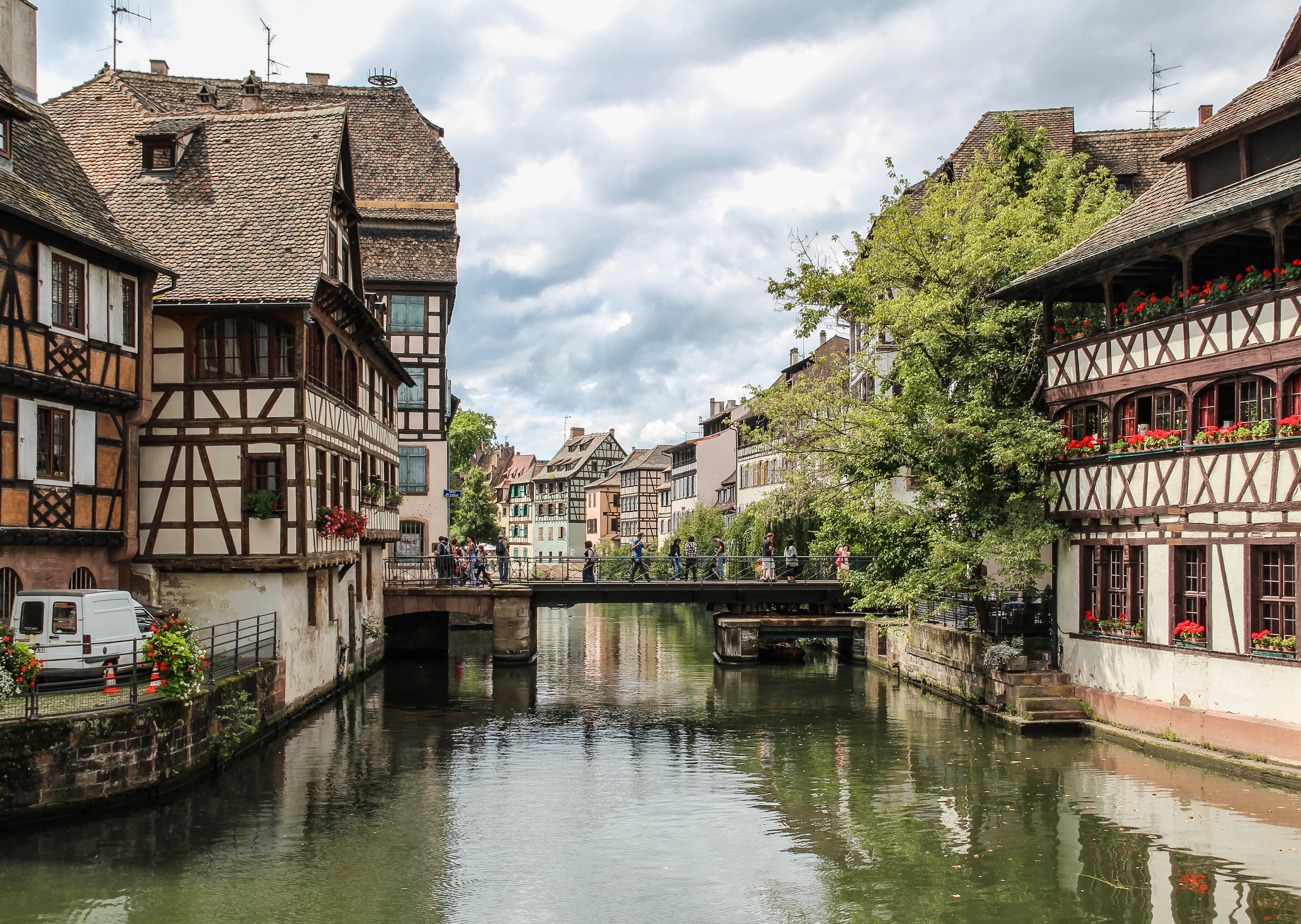
Start with a bakery breakfast, then walk toward Petite France through the western part of the Grande Île. Around Place Benjamin-Zix and the Pont du Faisan, look beyond the most photographed façade: water channels, bridges and the relationship between buildings and river make the district distinctive. Allow about 90 minutes for this small area with photographs and pauses. It is not necessary to march through every lane twice or queue for a particular picture if the riverside is busy.
Continue toward the Ponts Couverts and the Barrage Vauban area to widen the view. This is a useful progression from intimate canals to the city's former defensive landscape. Keep approximately 30 minutes for the connecting walk and exterior viewpoints, and treat any terrace or interior access as dependent on the posted opening arrangements. Wet stone can be slippery, while narrow bridges are shared spaces. A stroller or wheelchair route should be chosen for surfaces and gradients, not just the shortest line on a phone.
Make lunch a genuine break before the museum rather than something squeezed into a queue. The western centre is a convenient place to stop because the next attraction is nearby across the waterways. If you stay near the station, this is also an easy point to drop off purchases or collect a dry layer without crossing the whole city.
14:00–16:00: MAMCS, a specific rainy-day anchor
The Musée d'Art Moderne et Contemporain de Strasbourg, at 1 place Hans Jean Arp, gives the afternoon a clear purpose. Its collection spans art from 1870 onward, with connections to Arp and the development of modern art alongside better-known international names. Choose a few sections to explore carefully rather than expecting every famous artist to have a particular work on display. The current adult full tariff is €9, with a reduced tariff of €5 for eligible visitors.
The city's current opening information lists Tuesday–Friday 10:00–13:00 and 14:00–18:00, weekends 10:00–18:00, and Monday closure. The lunchtime break matters: a weekday arrival at 12:45 is not a sensible start for a two-hour visit. Last ticket issue is 17:30, but arriving then leaves too little time for the collection. Listed November closures include 1 and 11 November 2026. The city also lists a lift, wheelchair and folding-stool loans, and baby-changing facilities.
Afterward, return through the riverside area for a shorter late-afternoon walk if conditions are pleasant. If day one is Monday, move the museum to another afternoon and keep this day outdoors with a longer lunch. This small swap is preferable to travelling to the entrance and discovering a routine closure. Leave your first evening relatively simple: a booked Alsatian dinner and an easy return route will contribute more to the trip than another hour of compulsory sightseeing.
Day two: cathedral details, the clock and a view from above
09:30–11:00: see the cathedral before climbing anything
Approach the cathedral from more than one direction, allowing time to watch how its silhouette changes as the streets narrow. At the façade, look at the depth of the carved portals and the intricate stonework rather than spending the entire visit framing the spire through a phone. Inside, give attention to the stained glass, the vertical space and the Pillar of Angels near the clock. A quiet 45–60-minute visit is enough for a first orientation without pretending to exhaust the building's history.
The cathedral interior, the astronomical-clock presentation and the platform ascent are separate experiences. Plan them as such: their entrances, timing and physical demands differ. Respect worship and any temporary restrictions, and do not try to turn a service into a sightseeing slot. Carry a layer suitable for a cool interior and keep food packed away. For readers who find crowded enclosed spaces tiring, an early exterior visit followed by a shorter interior can be more rewarding than attempting all three experiences consecutively.
Late morning: plan around the astronomical clock
The tourist office's clock information gives adult presentation admission at €4, with entry for the film between 11:35 and noon through the south portal on Place du Château. The animated procession is associated with 12:30. It describes no film screening on Sundays, feast days or during the Christmas market. Because the listing also contains abbreviated timing language, use the actual ticket and entrance instructions for the chosen day rather than arriving at the last possible minute.
The attraction is a mechanical and artistic performance, not merely a large clock face. The moving figures give a brief narrative about time and human life; the surrounding sculpture deserves attention too. Keep the whole late-morning block available instead of booking lunch at noon across town. Children who like mechanisms may enjoy this more than a lengthy formal tour, but explain in advance that there is waiting and a short performance rather than a continuously moving show.
14:00–15:15: the platform, if stairs suit you
The cathedral platform is 66 metres above the city, reached by more than 300 steps from Place du Château. Adult admission is €10 and advance reservations are not offered. From October to March, listed opening is 10:00–13:00 and 13:30–18:00, with last evening ascent 45 minutes before closing. Wind, weather or crowd conditions may stop access. This is a weather-dependent choice, not a guaranteed appointment.
Allow approximately an hour for ticketing, climbing, looking and descending, with more time if a queue forms. The view helps connect the old centre to the larger city you will explore tomorrow. Do not attempt it merely because it appears on a must-see list: there is no lift alternative for this climb. If stairs, vertigo or mobility make it unsuitable, spend the same time on a boat excursion or an unhurried ground-level architectural walk. There is no need to pay for a physically uncomfortable experience to make the visit feel complete.
Late afternoon: cathedral streets and an optional boat trip
Use the remaining afternoon for the streets around the cathedral, including the exterior of Maison Kammerzell and the approach toward the Palais Rohan. This is also a convenient point for a tea-room stop, especially after the climb. Resist adding every museum in the palace complex simply because their entrances are nearby. The municipal museums' notices state that the Musée Alsacien remains closed for works, with reopening expected in 2028. The Decorative Arts Museum has partial closure from 21 September to 19 November 2026; its reduced visitor offer is not the full palace-apartment experience.
A boat trip can help explain how the city's waterways connect, and provides a seated alternative after walking. Batorama's published open-ticket tariffs list a long-tour adult ticket at €16.20 and a short-tour adult ticket at €12.50. These are the operator's open-product prices, not a promise that every dated departure costs the same. Confirm the route, boarding point and availability before purchase, and convert an open product into the departure arrangement required by the operator. For rain, check the vessel type; “boat tour” does not automatically mean a covered seat with the same visibility as an open deck.
Day three: Neustadt, European Parliament and Orangerie
09:30–11:30: a different Strasbourg around République
Begin at Place de la République, where the breadth of the streets immediately changes the pace of the visit. This is the Neustadt rather than the medieval lanes of the Grande Île. The city's heritage walk explains the connection between the late nineteenth-century administrative quarter and the historic centre. Read the square as an urban composition: formal buildings, garden space and long sightlines express a very different ambition from Petite France's tight waterways.
Follow Avenue de la Liberté toward Place de l'Université, pausing to look back along the axis. This is a straightforward walking sequence rather than a collection of disconnected façades. Allow 60–90 minutes including the square and architectural pauses, and add a café break before moving farther east. Building exteriors are the core of this walk; do not assume unrestricted entry to working institutions or university rooms. The tourist office's Neustadt guide gives further architectural context if you want to extend the route.
From the university area, use the current CTS journey planner for the European quarter rather than turning the day into a compulsory long march. Tram connections and the final walk depend on your exact departure point. Keep at least half an hour of practical transfer allowance, and more if you need an accessible connection. Have lunch before the institutional visit if your selected arrival would otherwise fall in the middle of the afternoon.
13:30–15:00: a free visit with real entry requirements
The European Parliament's visitor offer outside plenary sessions includes the Hemicycle, Parlamentarium Simone Veil and exhibitions. Visits are free and described as lasting around 60 minutes, with multimedia material in the EU's 24 official languages. Bring a physical passport or national identity card; a photograph on your phone is not the stated requirement. Allow additional time for security and orientation rather than treating the published visit duration as the entire door-to-door outing.
The outside-plenary schedule lists Monday–Friday 09:00–18:00, Saturday 09:30–12:00 and 13:00–18:00, with last entrance at 17:00; Sundays and specified holidays are closed. Plenary-session arrangements are different, so select the relevant visitor offer for your date. Individuals do not need a standard advance group booking under the outside-plenary rules. Travellers requiring assistance should contact visitor services beforehand. Keep headphones handy for the multimedia material and avoid carrying unnecessary luggage through security.
This stop is worthwhile because it gives Strasbourg a contemporary purpose beyond its old streets. Sit long enough to understand the scale of the debating chamber and use the interpretation instead of making it only an architectural photograph. With children, a short conversation beforehand about what elected representatives do makes the visit more intelligible. If your third day is Sunday, move this visit to an open day and use Sunday for the park and cathedral exterior instead.
15:15–17:00: finish with Orangerie, not another rushed monument
The Parc de l'Orangerie is close enough to combine naturally with the European district. Give it 45–75 minutes for a stroll, seated pause and a look at the landscape around the Pavillon Joséphine. It is particularly useful after a security-controlled indoor visit: there is no need for another audio guide or timed admission. Tree colour is a seasonal possibility rather than a promised spectacle.
In rain, shorten the park to the most comfortable route back to transport and return for a tea-room break in the centre. In good conditions, keep the afternoon unhurried and leave time for the tram journey and dinner. Avoid adding a wine-country excursion here. The point of the third day is to see another layer of Strasbourg, not to spend the final hours negotiating an unfamiliar regional connection before an evening train.
Alsatian meals: what to order and what it can cost
A winstub meal offers a useful introduction to Alsatian cooking. Choucroute pairs sauerkraut with substantial accompaniments, often pork and charcuterie; tarte flambée is a thin, crisp shared dish whose classic topping includes cream, onion and bacon. Baeckeoffe is another traditional choice to look for. The tourist office's restaurant guide distinguishes local specialities, traditional dining and tea rooms, making it more useful than choosing solely from photographs outside a door.
Make one dinner the regional meal you care about, then keep other lunches lighter. A bakery breakfast, a seated lunch and an early dinner suit the walking schedule better than repeatedly postponing food until every attraction is finished. For a vegetarian or vegan traveller, clarify the stock, dairy and toppings: a dish based on cabbage or potatoes is not automatically meat-free. A tarte flambée without bacon may still contain dairy, so ask for the actual preparation you require.
For a named price reference beside the cathedral, Maison Kammerzell's current published speciality page lists its three-fish choucroute at €29.90 and Strasbourgeoise meat choucroute at €26.75. Two people choosing one of each would spend €56.65 on those mains alone, before drinks, starters or dessert. This is a specific restaurant example, not the average price of every Alsatian meal. Book the restaurant if it matters to you; do not assume that a famous central address will have an immediate table at peak dinner time.
For something smaller between visits, look for a bretzel or kougelhopf in a bakery and compare the displayed price before ordering. Leave purchases that need careful packing until later in the day. A wine tasting or elaborate dinner can be an enjoyable addition, but neither is necessary to understand the city's food culture, and alcohol-free travellers can follow the same route without losing its main experiences.
Budget the confirmed parts, then add your own hotel and meals
| One adult | Confirmed example | What it includes |
|---|---|---|
| Three separate 24H SOLO periods | €14.00 | Three €4.60 tickets and one €0.20 reusable support |
| MAMCS | €9.00 | Ordinary adult full tariff |
| Astronomical-clock presentation | €4.00 | Adult presentation admission |
| Cathedral platform | €10.00 | Adult ascent, if weather and mobility permit |
| European Parliament | €0 | Free visitor offer, subject to entry requirements |
| Transport and admissions subtotal | €37.00 | Excludes airport train, boat, hotel and meals |
You may need only one 24-hour urban ticket if you walk the first two days. Buying just one with its initial support makes the same admissions-and-transport subtotal €27.80. An optional €16.20 Batorama long open-ticket product would increase the three-ticket example to €53.20, subject to that product matching your intended sailing. Keeping optional costs separate prevents a seemingly cheap city pass or package from distorting the real comparison.
Hotel rates, long-distance travel and the airport fare are excluded because they require your actual dates and ticket conditions. The restaurant example above shows how to add a confirmed meal without inventing a citywide daily food allowance. For a couple, calculate individual admissions and meals separately; for families, check the age rules rather than simply multiplying adult prices. A good autumn budget leaves room for one indoor substitution when the weather changes.
Accessibility, families and common planning errors
The historic centre's compactness helps families, but compact does not mean universally smooth or step-free. Break the canal walk with a seated pause and give children a concrete detail to find, such as a moving bridge or a carved animal, instead of asking them to admire architecture indefinitely. The platform climb is optional. MAMCS offers listed family and access facilities, while the park provides a useful open-air interval after the Parliament visit.
For reduced mobility, choose the exact hotel entrance carefully, use trams for longer eastern-city journeys and contact attractions about the route you will need inside. A canal-side staircase can make a short mapped route unsuitable. In bad weather, retain the cathedral interior, MAMCS and Parliament on their open days, and reduce exposed walks. Do not rely on the closed Musée Alsacien as your fallback or on a partially closed palace museum delivering the full visit shown in older guides.
The other frequent mistake is overextending the region. Colmar and wine villages deserve their own properly researched day, with transport connections and cellar appointments. Adding them to a three-day Strasbourg plan means removing something here. Travellers who mainly want vineyards should choose that priority explicitly instead of losing city time to an improvised excursion that ends with a stressful return.
Frequently asked questions
Is Strasbourg worth visiting before the Christmas markets? Yes. The cathedral, waterways, Neustadt, art museum and European institutions give this route its substance independently of market dates.
Can I visit the Musée Alsacien this autumn? No. The municipal museum service says it is closed for works, with reopening expected in 2028.
Is the cathedral platform accessible by lift? The visitor offer is a stair climb of more than 300 steps. Choose ground-level views or a suitable boat option if that is unsuitable.
Is the Parliament visit really free? The official outside-plenary visitor offer is free, with security and physical identity-document requirements. Check the correct schedule for your chosen date.
Do I need three days? Two days cover the old centre well. The third adds Neustadt and the European quarter without sacrificing time for meals or a museum.
Should I hire a car? This city route uses walking, urban transport and rail arrival. A car adds parking decisions without helping the main sightseeing sequence.
Research notes
Prices, closures and practical details checked on 11 October 2026 against the official sources linked above. Amounts are in euros. Timings and neighbourhood comparisons are editorial suggestions. Published open-ticket boat tariffs are identified separately from date-specific sailings; unverified rail and accommodation costs are not included. Reconfirm the chosen day for religious access, parliamentary arrangements and holiday closures.